As Virginia Beach locals, we all know Mt. Trashmore Park, whether you attended a local festival or spent a day full of family-friendly fun there. But what if I told you it had an even deeper history of skateboarding culture?
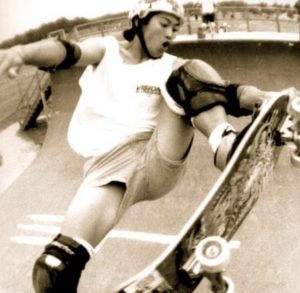
In the late 1970s, a soapbox derby track was built at Mt. Trashmore Park in Virginia Beach, Virginia. It was originally intended for speed cars, but it eventually became one of the only places to skateboard in the city. Transitioning into the late 1980s, the original vert ramp was constructed, drawing in skateboarders from all over the East Coast. It was dominated by Virginia Beach locals known as the “Fork Crew.” My dad was one of them. However, before talking more about the legacy, I had to ask my dad exactly how this came to be.
It was the summer of 1989, and punk rock blared through the house. In the middle of the party, my dad’s friend yelled, “Oh yeah, you think you guys are punk?” and took a heated three-pronged fork to his arm. My dad and his friends shouted, “OH NO WAY! That’s crazy, bro.” Yet, as the night went on, one by one, everyone got branded by that same fork—my dad being one of them. That scar, still present on my dad’s shoulder today, tells a larger story about the local skateboard community he helped create in the 1980s.
My dad and I sit in the dimly lit living room of his childhood home, which makes this conversation feel so much more nostalgic. He reclines comfortably in the leather sofa, still in his dirty, blue-collar work clothes that radiate a slight stench of sweat and hard work. I sit right across from him, eager to know every single detail as I begin bombarding him with questions about why he even started skating in the first place. “I was always playing neighborhood games with my friends and even my cousins who lived right down the street. But, you progress from those neighborhood games, so in junior high school I decided to try wrestling,” he answers. I sit listening intently as my fingers glide across the keyboard, trying to keep up with his energetic, talkative personality. “I stayed after school every day training, but when the list came out for the wrestling team, my name was not there.” His tone shifts as he laughs at himself like that rejection doesn’t matter anymore. I let out a chuckle as he continues, “and that’s when I turned to skateboarding, I didn’t wanna be on a team where the coach told me I wasn’t good enough even when I put in so much effort.”
My dad has always told me stories about how he’d skate literally every day after school, but I never truly believed him until this moment. When I ask about his first skateboard, his eyes widen and his forehead lines deepen, taking a pause before telling me, “I was probably 12 when I got my first board, but it was a tiny, cheap, plastic one from K-Mart.”
Before the vert ramp at Mt. Trashmore was built, my dad and his group relied on backyard ramps. My dad gets really excited as if he’s a teenager again when explaining, “Man, in middle school music transitioned from alternative to punk rock, so everything became about rebellion.” I slightly smile when he continues, “Back in the day, the 80s was all about being punk and rebellious. So me and my friends would build our own ramps. We would steal plywood from construction sites…there were no cameras then.” My jaw drops, but he keeps going. He tells me, “We tried to skate everything and anything. We even skated on top of cars with little slanted roofs,” gesturing with his hands. He reflects, “Now you look around and they have concrete parks everywhere. It’s like everyone skates nowadays, but we were the OGs.”
The local skate scene became so popular in the 80s that local shops began noticing. Something that was just a fun neighborhood hobby would transform into competition and even professional careers for many of my dad’s friends. For my dad, however, he first gained recognition from Island Water Sports, an old shop that was located on 24th street at the Oceanfront. After that, he became a part of 17th Street Surf Shop’s amateur team, riding among his closest friends. “I got free skateboards from my sponsors. I didn’t start buying clothes until my 20’s because of 17th street,” my dad’s smile widening. Yet, for a second, the whole mood of the room changed. My dad says with a more serious tone, “You don’t just become good at something. You have to put in a lot of effort. There were always cuts, bruises— I spent a lot of my 20s on crutches.”
Decades later, that three-pronged scar still rests on my father’s shoulder. Watching my dad tell me all his crazy stories as if he’s a teen again helps me realize that skating was so much more to him than just a hobby. It was his therapy, motivation, and most importantly, the connection to his friends.