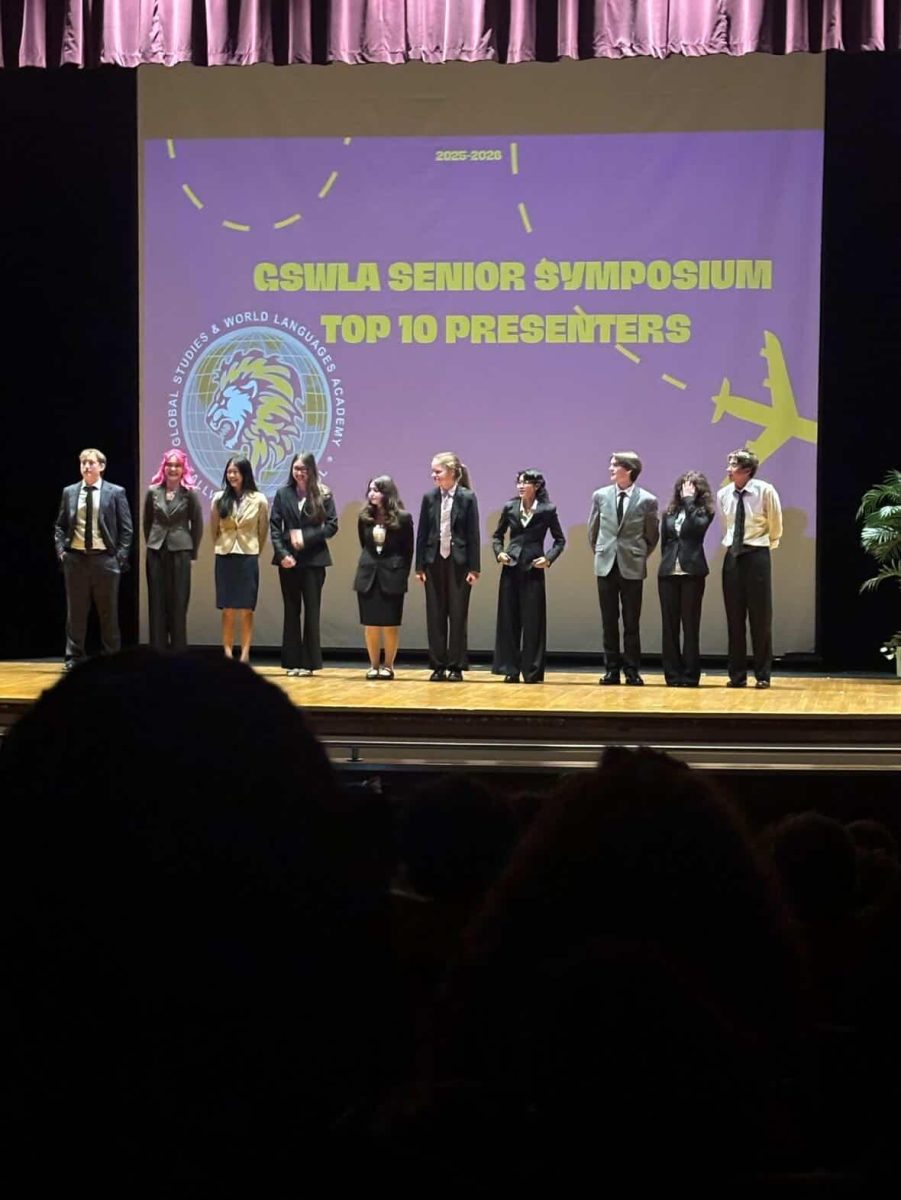
8:50, Wednesday morning. People began shuffling into the Schola at Tallwood High School, flattening the foldable seats row by row. As they came, so too did the chatter of antsy conversation occasionally interrupted by a teacher shouting instructions to their class. The stage was illuminated by a series of warm spotlights; each one cascaded down onto the thrusted platform and the white projector screen that hung behind it.
In the frontmost row, a group of five students sat either wringing their hands in their lap or gazing vacantly at the growing audience. They were costumed with proper attire. They wore buttoned-up tops and pressed bottoms, dress shoes or modest flats, hair styled to exude professionalism, and a smile. One by one, they took the stage with a clicker in hand. Beneath the sea of those blazing hot spotlights, they were given one choice: sink or swim.
This is the experience of nearly 100 seniors at the Global Studies and World Languages Academy at Tallwood High School every year. These students are tasked with developing a research project on a selected issue of concern, which eventually culminates into a final presentation to showcase their findings.
The fortunate part is that all of them had been taking lessons. They had been informed about their coming presentations for a matter of months by then, and they had no trouble heeding the words of Global Connections Seminar instructor Lindsey Clouser when she advised them to adequately prepare.
What’s fascinating is that in spite of the variety in their subjects, their strategies in rehearsing were nearly universal.
I joined Kylie Quiambao and a group of other presenters in a study room at the Tidewater Community College Joint Use Library a day before their presentation. These students sat around a table with their laptops open, flipping between the rubric that they would be graded on and the slides being curated. Instead of sophisticated academic terminology, Quiambao often allowed herself the catharsis of “blah blah blahs.” She even skipped certain parts of her speech in entirety if she felt comfortable enough with them. In spite of the event’s serious nature, she managed to make the activities prior to it engaging and entertaining.
Fortunately, this methodology worked to her benefit. Quiambao presented her research on the psychological impacts of government corruption on children, earning herself a position in the Global Studies and World Languages Academy’s top 10 presenters. I got the chance to speak about her thoughts on the preparation she did in the moments of relief that followed.
“The practice we did as a group allowed me to get instant feedback,” Quiambao explained, “which allowed me to get instant feedback and critiques that later translated into my success in the presentation.”
Taylor Burch employed similar preparation methods within the confines of her home. In an interview, she stated that she “presented to [her] dogs, [her] parents, and a small group of [her] friends” as her principle method of practice. She described it as a stepping stone: a middle ground between the absurdity of talking to oneself in the mirror and the reality of feeling the spotlights washing over you.
To her, presenting in front of a smaller, more familiar audience gave her “the exposure that [she] needed” to perform well in front of the judges. Burch, like Quiambao, leveraged her community as a valuable device to manifest success in her final presentation on tea as a cultural unifier.
Usually, these methods are coupled with practice alone as well. Kylie mentioned running through her presentation without the slides in the car in order to “memorize her script,” and Taylor admitted to doing the same in front of her mirror.
It was shocking to discover, however, that Koehn Humphries was so confident in the potency of peer review that it was all he relied on.
“I practiced the day before with my friends,” Humphries said, “but that was about it for my preparation.”
His style, as unconventional as it was, gave him a sense of security in the result. When asked to pinpoint his feelings about his presentation on coffee and the concept of a third space in one word, he simply said, “Happy.”
Everyone goes about tackling nerve wracking situations like this differently, but these testimonies reveal that community is a convention. Only after presentations were over did it become clear that an activity revered for its feelings of isolation and fear can look more like a source of belonging and comfort for students in the academy. Sure, they may have spent eleven minutes alone on that stage with nothing but a clicker and a smile, but the bouts of applause that followed were a poignant reminder that they had hours worth of support less than a row away.