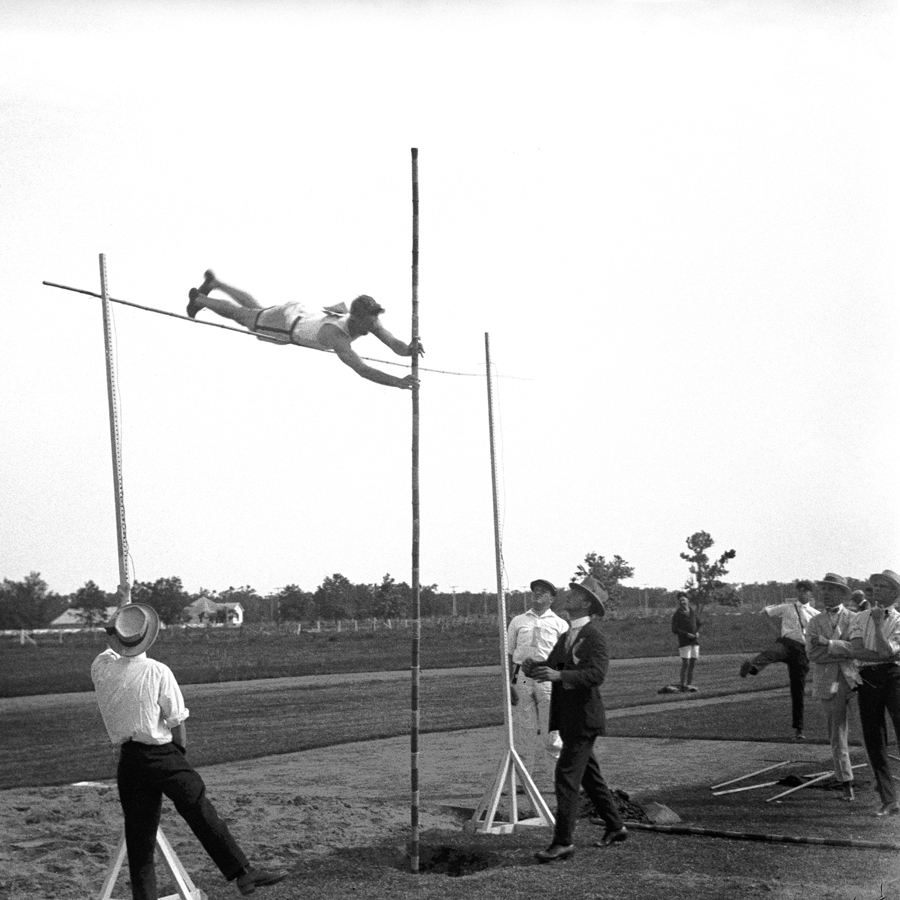
- Here I Come, Princess!
What started as a practical way to clear fences and ditches to save the prettiest woman in the land has grown into a highly technical and exciting sport. According to Encyclopedia Britannica, the pole vault became an official competition in the mid-1800s, appearing in the first modern Olympic Games for men in 1896, with the women’s event joining over a century later in 2000.
2. Spring to New Heights
Early vaulters used wooden or bamboo poles equaling no bounce or bend at all. Modern fiberglass and carbon-fiber poles bend, store kinetic energy, and snap back like a giant spring, launching athletes into the air. This technological advancement has evolved the sport, allowing vaulters to jump higher with less strain. The flexibility of modern equipment tailored to their speed, weight, and technique puts their efficiency to 100%. As pole design continues to advance, so does the potential for record-breaking heights.
3. Physics in new motion
Vaulters turn running speed into height by converting kinetic energy into elastic energy in the pole, and then into gravitational potential energy. A great vault is all about timing and efficiency–wasting energy means losing height. Armand Duplantis the world record holder and title holder of “G.O.A.T.”(greatest of all time) maximizes his speed and the science behind the vault. He uses perfect timing at takeoff, an efficient plant, and precise body positioning to ensure that almost none of his energy is wasted.
4. Four-Part Flight Plan
Every jump follows the same thrilling sequence: Sprint, plant, bend, flip, fly. Each phase must flow smoothly into the next to turn forward speed into gravity-defying height. While a precise plant anchors the body for takeoff. The bend stores energy like a coiled spring, and the flip unleashes it in a burst of motion that sends the athlete soaring. In the final moments of flight, time seems to slow as the jumper rises higher,suspended between the ground and bar. With each phase completed, and masters the athlete gains confidence, control, and power and becomes one step closer to touching the stars.
“The optimum technique is to run-up as fast as possible.
5. Smarter Technique Keeps Vaulters Flying Longer
Jumping higher isn’t just about going faster–it’s about jumping smarter. Coaches now use video analysis, sensors, and bio-mechanics to fine tune technique, boost performance, and reduce injury. This helps the athlete improve their vault and be much safer. By studying how the body moves through each phase of the jump, coaches can spot small mistakes that might otherwise go unnoticed. These adjustments allow athletes to use their strength more efficiently, generate greater lift, and maintain better control in the air. Over time, this smarter approach leads to higher jumps, more consistent results, and longer, healthier careers.